Tuesday, December 7, 2021

Bite-Sized Book Reviews: Part III

This book review was written as part of a series for the Oregon Council of Teachers of English in Spring 2021.


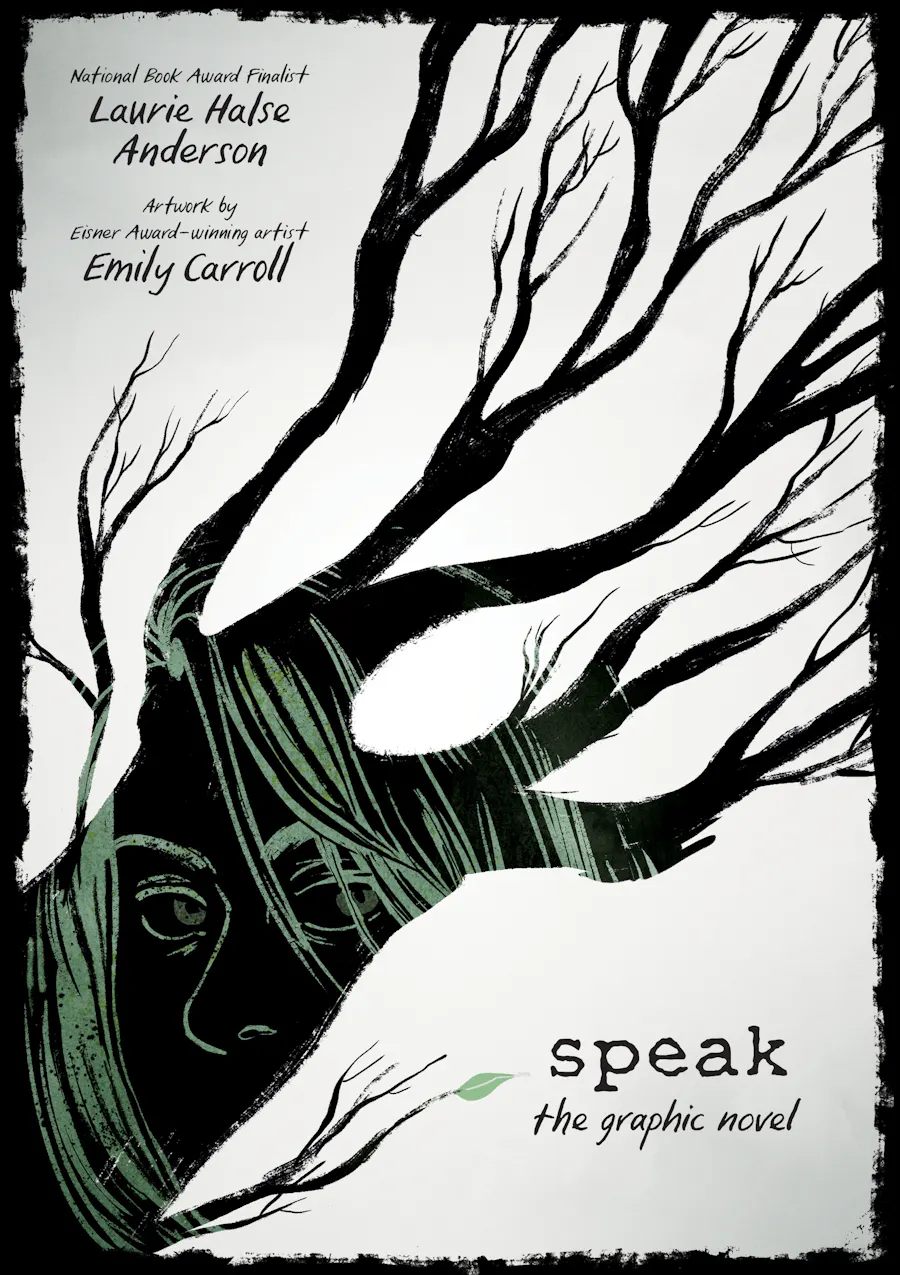
Speak: The Graphic Novel (2018) by Laurie Halse Anderson and artwork by Emily Carroll


Laurie Halse Anderson’s novel Speak ushered in a provocative new era of YA literature when it was first released in 1999. Narrator Melinda Sordino, a ninth grader, unflinchingly guides us through both the universal—the perpetual indignities of high school—and the personal—as she describes it, “My Summer Vacation: A Drunken Party, A Rape, and a Shunning.”


Terms like consent and trauma were not yet part of the mainstream lexicon. The #MeToo movement was 18 years away from tearing through our culture of silence and shame; soon afterward, Anderson would reveal she was a survivor of sexual assault herself. 


More than two decades after the original novel’s publication, the graphic novel adaptation of Speak brings Melinda’s voice to a new generation, rendering her story in an affecting fusion of haunting and whimsical imagery.


Cover art: Emily Carroll


An accomplished horror comics artist, Emily Carroll expertly utilizes light and shadow to distill Melinda’s struggles down to their essence, conveying the sensory experience of trauma and its aftermath. Nuanced visual details enhance Melinda’s incisive observations and compel the reader to linger on each page. 

Melinda initially asserts that “it is easier not to say anything,” then, inspired by Maya Angelou, the suffragists, her caring art teacher, and a few peer allies, she eventually gathers enough strength and trust to share her story and shed her old belief that “nobody really wants to hear what you have to say.”

This new iteration of a modern classic ensures its place both inside and outside of the classroom as an enduring tool of revolution, reminding us it is not a book for only women and girls. Updated with technological references and language for the 21st century, it is a rallying cry for each of us to use our voices in the brave conversations all our students and fellow humans deserve.

Tuesday, November 30, 2021

Bite-Sized Book Reviews: Part II

This book review was written as part of a series for the Oregon Council of Teachers of English in Spring 2021.


Circe (2018) by Madeline Miller


If it were up to Homer, most of us would only know the most recycled and frankly tired version of the goddess Circe: Odysseus arrives on her island, discovers her penchant for porcine curses, seduces her, then accepts her invitation to stay.


Madeline Miller’s Circe gives new voice to an ancient character, offering a complex and vivid portrayal of a woman denied her full glory in the classical canon. This novel of mythological realism is the latest rebuke to millenia of male authorship that relegates Circe to a secondary player whose main purpose is service to plundering men.


Cover design: Will Staehle


Daughter of Helios and naiad Perse, lesser nymph Circe is both an outsider in the world of gods and within her own family. She has little appetite for the gods’ economy of cruelty and “the great chain of fear” upon which their power depends. She is disgraced and then exiled for her early, pride-fueled experiments with herbs and magic; these transgressions are the catalyst for her transformation.


The “Mistress of Beasts” is paradoxical in multiple ways: she finds her first true freedom in her confinement to Aiaia and searches for her place within the tangled cosmogony of gods and mortals as “the dread goddess who speaks in human tongues.” A self-sufficient and sometimes lonely single mother who is both emboldened and haunted by the consequences of her gifts, she doles out divine justice to ship after ship of unwelcome sailors who regard women as “an endless feast laid out upon a table, beautiful and renewing. And so very bad at getting away.”


When the tension of her choices reaches a climax, Circe thinks, “I cannot bear this world a moment longer.” She gets her answer: “Then, child, make another.”


Thankfully, Madeline Miller does that for the story of Circe, and for us.


Monday, November 22, 2021

Bite-Sized Book Reviews: Part I

This book review was originally published by the Oregon Council of Teachers of English (OCTE) in Spring 2021.


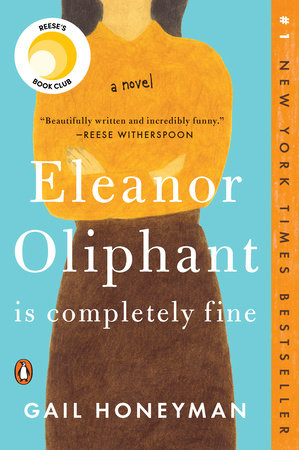
Eleanor Oliphant is Completely Fine (2017) by Gail Honeyman


In our study of the hero’s journey, I ask students to broaden their concept of the traditional grand epic with its limiting landscape of exclusively male heroes. Cast yourself as the unsung hero in your own journey, I tell them.


Do not wait for demigods to swoop in and save you; choose to save yourself, one quiet act of courage at a time. The interior journey of the heart and soul is just as transformative and often more harrowing than tales of beast-battling warriors.


Enter the title character and unassuming hero of Gail Honeyman’s debut novel Eleanor Oliphant is Completely Fine, who reminds us that sometimes the most heroic feat is to simply keep going. We meet the 29 year-old self-described “sole survivor” and “self-contained entity” in the midst of her very small and almost pathologically independent existence. 


Cover Art & Design: Jaya Miceli/Soleil420

Socially oblivious and hilariously deadpan Eleanor crafts a plan to change her life by pursuing a narcissistic musician, yet her real call to adventure comes in the form of the bumbling office IT guy enlisting her reluctant aid to a stranger who collapses on the street.


She is then nudged out of isolation by mentors and guides who eventually catalyze her to face the horrors of her past, speak the truth about them aloud, and learn to open her heart.


At one point, Eleanor asks, “How do I fix me?” to which the answer is, “You’re doing it already, Eleanor. You’re braver and stronger than you give yourself credit for. Keep going.”


Like Eleanor, we all long to “solve the puzzle of me.” In this story, the hero’s choice is not whether to sacrifice herself for others in the vein of the classic epic, but whether to sacrifice her carefully constructed world in order to save herself. 


Monday, November 13, 2017

Making Room in an Occupied Heart

I wrote this essay several years ago, and it won an Honorable Mention in the 2014 Oregon Writers Colony contest. After the contest, I meant to do something more with it, but other projects got in the way. Even though my life has evolved and I would tell the story in this piece differently now, its themes still form the foundation of most of my writing. So today, I mark where I've come from by sharing what felt truest to me in an earlier time.


            “You can start by peeling all of these,” Paul said, gesturing toward the sink that contained a small mountain of apples. Maybe a bushel? I thought, which pulled in a scrap of song:

I love you, a bushel and a peck
A bushel and a peck and a hug around the neck

I opened my mouth to sing this, but stopped myself. The L-word had not yet been exchanged between this man and me, although I’d felt it forming on my lips for the past few weeks.
Stay focused, I admonished myself. My new boyfriend was a tall, blond Swedish-Norwegian hybrid, a Lutheran transplant from Minnesota, which by default meant he was a canner. A bookshelf next to the front door of his apartment housed jars of green, red, purple, and pale yellow—pickles, salsa, spaghetti sauce, plum sauce, applesauce, and pear ginger jam—products I was the recipient of by our third date.
And now I’d accepted his invitation to make a friend’s apple windfall into something useful. Of course, I turned the opportunity into a girlfriend proving ground. How could I compete with the family of women he must have back home, peeling and slicing and baking and canning their asses off until their basements could sustain them through a nuclear holocaust?
            “Sure,” I said breezily, taking the vegetable peeler he held out to me. My mother’s idea of a home-cooked meal was a jar of Ragú unscrewed and poured over a pile of spaghetti while frozen broccoli pieces defrosted in the microwave. The only preserved food in the house was a block of Velveeta. As for myself, I wouldn’t bake as long as I lived alone, because I would eat one cookie, and then the whole batch. I prayed I wouldn’t have to end up admitting this to Paul in the name of modern intimacy.
            As I picked up the first piece of fruit and ran the peeler’s blade along its mottled red skin, metal clanged behind me. I turned to see Paul set on the stove a pot a small child could hide inside, and on the counter beside it, a set of tools I can’t identify: a metal cone dotted all over with tiny holes, a pointed wooden pestle inside of it, and dark green plastic pieces in various shapes and sizes.
            I was supposed to meet his good friends for the first time that night at their house for dinner, but I’d rather have just gone back home alone. The truth is that I sometimes hate getting to know people. I like people. Or at least some of them. But I hate the process, the parading around of interests and the asking of endless questions. My inner pessimist just sees the dead end of this—the way more information brings us closer to each other’s inadequacies.
             I needed a break from this early-relationship phase of learning, explaining, and introducing. Sometimes I wished I could just fast-forward to five years in when we didn’t have to be on our best behavior anymore. When I told Paul, “I’m a moody person,” I wanted him to know what I was talking about instead of saying, “Really? I can’t picture that. You seem so happy all the time.”
            I would have to get everything out in the open soon. I just wished he could already know all this and I could skip the explication part.

*          *          *
 
Like the fact that at 20 years and counting, my eating disorder was easily my longest relationship.


Its many guises and attendant rituals permeated everywhere I had ever lived. I made a space for it in my living room, when it told me my six-mile run wasn’t enough, so I had to do some emergency calisthenics on the floor to redeem myself. It haunted my closets and dresser drawers, taunting me to try on jeans from 10 years ago to see how fat I was now in comparison.
In the kitchen, it would hover over me at the fridge, whispering judgments and neurotic calculations about what I already ate or was going to eat for dinner. At times it lapsed into a permissive personality, calling me to eat for hours at a time on the couch, promising escape but delivering only shame. Always there in the mirror, it harangued me about my inner thighs’ overly cozy relationship with one another.
And in bed with a man, it was an awkward third party, stabbing through any pleasure I felt with a running commentary on how repulsive the little roll below my bellybutton must look.
Addiction and intimacy cannot mutually co-exist. In each of my attempts at real love, my disease eventually won out. In every relationship, I used whatever energy I had left after obsessing over food, not eating, binge-eating, compulsively exercising, scrutinizing my body, and hating what I sawwhich meant I had only a shred of a self available to another person. I thought my big passions and intense personality automatically connected me to others, but I was holding out in the ways that truly counted.
As long as I let addiction take up residence in my heart, I could shut out even the people who wanted to be closest to me. When boyfriends told me I was beautiful, I would dismiss the compliment, pointing out the stretch marks that had battle-scarred my body since I was 17.
One night when I was 21, the first man I lived with came home to find me violently destroying a pizza I had originally intended to have for dinner. A scrap of latent anorexic thinking had dislodged itself from my subconscious and floated to the surface, telling me I was too fat to deserve to eat. “You’re okay, you’re okay,” my boyfriend repeated, trying to calm me, but his words were white noise against the louder drone of self-destruction in my head.
While living in Spain a few years later, I canceled a date with my British boyfriend because I was homesick and just wanted to binge in peace in my apartment. No one could ever find out about this secret ritual, so I made up an excuse about needing rest after a long workday. When he yelled into the phone, “You always need alone time!” it struck me just how easy the choice between food or another person always was.
At 28, I was driving my then-fiancé to dinner when he pulled out an empty cookie package I had hidden in my glove box. And then a bottle of weight loss pills, the mortifying kind that extract the fat from the food you eat, which you then expel into a toilet—if you’re lucky enough to get there first.
“Maybe if you didn’t eat this stuff that makes you hate yourself, you wouldn’t feel like you need to take these,” he said quietly, trying to make sense of the weird evidence juxtaposed in his hands.
They all were trying to help in their way, but I only retreated further.

*          *          *

At 33 and a few months after my first canning lesson, I was committed to my Midwestern Lutheran Paul, who made the rest of the world fall away when he interrupted a set with his band to serenade me with Coldplay’s “Green Eyes,” and who told me I was the best thing that had ever happened to him.
I wanted to believe him. But really, I was like a philandering spouse, shamefully wrapped up in a relationship on the side, one that would always entangle me by sheer virtue of its longevity and familiarity.
I knew how all this sounded. Why not just stop doing it? I loved this man, but a scrap of addiction lingered in the background, a borderline-personality, lipstick-smeared girlfriend yelling, “You’re nothing without me! If you leave me, I’ll kill myself!”
I’d been trying to break up with my eating disorder for most of its existence, but like any codependent relationship worth its salt, it would not be fooled by any half-assed attempts to cut ties.
When the same fiancé who found the contraband in my car accused me of being an addict, I went to a 12-step meeting solely to prove that I wasn’t. What I saw there astounded me: regular people, in various stages of wreckage and repair, laying bare their deepest vulnerabilities and most humiliating struggles in order to be free of them. It took all the courage I had just to walk into the room and stay seated while my heart pounded the entire hour, and I scurried away before anyone could talk to me. But these people knew something about living that I clearly didn’t.
So over the next three years, I found myself back in that room again and again, even after my fiancé left me. I slowly learned the brave work of sharing my story and working the steps, and I felt my eating disorder start to loosen its grip on my life.
And then, Paul wanted me to move in with him. While packing up my apartment, I appraised every chair, photograph, and houseplant. Some sacrifices were immediately obvious: clothes I hadn’t worn in months or years, undergrad textbooks, art projects I would never finish. Paul’s leather couch was nicer than my futon, and his desk should replace my rickety IKEA table.
But my eating disorder wouldn’t be so easy to leave behind. The disease was still there—if slightly diminished—and now claimed squatters’ rights. Letting it stay meant always having an excuse to not be fully present, a twisted insurance policy against getting hurt.

Maybe this was just the best that I could get.

*          *          *

A few months before moving day, my body declared a mutiny. I’d tried to ignore bursitis in my right hip for half a year, but eventually the burning pain intensified. Running became impossible, and even my walk became a limp at times. The little bit of rest I allowed myself evolved into chronic exhaustion. I would come home after working 10-hour days at my teaching job and lie down on the couch, too drained to move. Over the next few months, I had to resort to my biggest work trousers—once again—and my bras barely contained me.
I desperately wanted to be the cool girlfriend, transcendent of such clichéd afflictions. Yet I was biding my time, anticipating the nervous energy that always returned, which I counted on to fuel my next workout craze and weight loss. To spare Paul, I’d vowed to stop voicing negative comments about myself, but a private ticker tape still ran inside my head.
I tried telling myself that I needed to exercise over an hour every day, and go to bed hungry—whatever it took to transform my body back into a carefully controlled machine. But I couldn’t summon the mania anymore, and I realized that for the first time, I didn’t want to. Instead, I spent my time with a partner who knew about my chaotic past but who didn’t cast me in the same tired script I’d followed for so long. As we hiked mountain trails, drew up a bucket list of travel destinations, and planned our home together, I had no energy left for old compulsions.
Sure, my body got a little bigger. But life was bigger now, too, and I refused to let the relics of addiction take up any more space in my home, my heart, and my mind.
The hard truth is that the moment we invite an eating disorder to live inside us, we also create a room for it that cannot be destroyed. Still, there is hope: each day we can decide to keep the room’s door shut. This is the power of a quiet courage, one that leads us down the path of change through the tiny brave actions that we must choose, moment by moment, day after day.

*          *          *

Before moving day, Paul took me back home to Minnesota to meet his family. On an especially humid afternoon we went swimming, and someone had the idea of a diving contest.
“Now, it’s whoever does the best animal!” Paul’s niece yelled.
My heart started pounding. I looked up at the board, casting its long shadow over the protective waters that hid my rippled thighs. Here was a group of people who had already welcomed and loved me, who simply wanted me in their lives, and who didn’t give a damn about my body fat percentage.
When it was my turn, I hopped up on the board. I could feel my butt jiggling as I did a slapstick walk to the edge, but I was laughing too hard to really care. Flapping my arms like a broken marionette, I screeched out a loud “Ca-caaaw!” before stag-jumping into the water.
I realized I’d brought the body I am supposed to have, along with a new sense of confidence that no one cared what it looked like.
Luckily, it was easy to disguise the tears on my wet face when I came up for air. Because I wasn’t worrying about cellulite, I only felt joy when I heard Paul’s little niece proclaim, “You’re the winner!”

*          *          *

But the ending of any relationship, even an abusive one, is tinged with nostalgia and doubt. As I unpacked boxes of photo albums in my new home with Paul, I found a picture of me at 13. I am standing on the shore of Lake Erie in a high-cut, one-piece purple swimsuit, self-consciously pushing my narrow hips forward to exaggerate my drum-tight abs. “See?” a little voice whispered. “We were so good together. Look at all I did for you.”
I paused, inhaling deeply, then closed the door in my mind and ignored the muffled protests as I walked away. 

 Post-script

 More than five years later, I still have to practice walking away. Moment by moment. Day after day.

Sunday, October 11, 2015

OWC 2015 Contest

I recently found out I won third place in the Nonfiction First Chapter category in the Oregon Writers Colony 2015 contest! The OWC describes itself as "a haven for writers," and over the past few years, I've found them to be a wonderfully supportive resource within my local writing community. Learn more about them here.

After winning an Honorable Mention in the Nonfiction Short Story category in 2014, this year I submitted an excerpt of the first chapter of my memoir, which is still very much a work in progress. Rather than waiting to share it until I think it's perfectly revised, I decided to go ahead and post it in its current state. I hope you enjoy it.


ONE

Late January 2008

     Contemporary wisdom says that half of all teachers don’t make it past their first five years on the job. On the morning of the 90th day of my own career, I stare into my reflection under the fluorescent lights of a staff bathroom, and my mind clenches around this idea like a boa constrictor. It’s 7:30. Most of the 89 mornings before this one have started the same way: me standing within the gray-tiled walls that have become my panic room while I run through all the repulsive things I have to address before I can manage to live another day standing in front of a room of 14- and 17-year-olds.
     The whole enterprise at this point feels like, in the jargon of the cape-wearing Dungeons and Dragons-obsessed teenagers who asked to hold a role-playing game club in my room every Wednesday since the third week of school, “an epic fail.”
     Anything and everything that happens at my job seems to remind me of my incompetence at being a well-adjusted human. I walk around feeling like an open wound every day, not just thin-skinned, but as if throughout the process of leading, managing, and connecting to six classes of teenagers—160 in all—my skin has dissolved completely and melted into a transparent membrane that exposes my entire inner workings, like one of those deep-sea creatures whose heart you can see beating inside of its body. Every interaction and every piece of information I confront is a glaring reminder of how ill-prepared I am to navigate this world fraught with high-stakes emotional transactions and endless decisions.
     I run my hand up the back of my head. My hair’s slowly growing back since I’d hacked at it almost two months ago. The Sunday night after I’d returned from visiting my grandparents for Thanksgiving, my on-again, off-again boyfriend Jack had sat me down on the floor of my attic bedroom and told me that he “just didn’t want to be in a relationship.” He continued, “It’s not you, it’s just that I don’t want to be anyone’s boyfriend right now.”
     The following Friday night, after a few of my trademark tonics-with-mostly-vodka at home, I had one of those fits of inspiration that only anger and fear and alcohol can generate. I decided that I didn’t need to actually schedule the haircut I’d been contemplating all week—I could just as easily do it myself in front of the bathroom mirror. My hair was dark, thick, and lustrous, which I had never before experienced as an adult. I’d finally gotten sick of the various short, punky cuts of my early twenties and grown it out over the past few years, and it was now halfway down my back.
     God, I’m so ugly, I thought as I stared at my drunken face in the mirror. My ends are so scraggly and all this hair is so heavy and frumpy. I need something more...modern.
     I grabbed the middle back section of my hair, brought it around to the front of my left shoulder, and chopped off a couple inches. Using a tiny compact as my rear-view mirror, I quickly worked my way along the ends of my hair, trying to create a cascading effect that left the sections framing my face longer in the front. I hacked randomly and at various angles.
     The way I worked at my hair was not unlike the way in which I would cut away at a block of cheese: I’d make one slice along the side, which would invariably not be at a perfect right angle to the cutting board, so I’d have to keep slicing until I’d re-established a straight edge. I’d eat some of these pieces as I worked and laid others on the counter for my post-ritual snack. When the edge of the cheese was straight again, I’d decide I needed another slice, and the whole process would start all over, more often than not until the entire block was gone.
     The sudden thought of that cheese shot enough sense into me that I put down the scissors and called an intervention on myself. If I kept this up, I would have no hair left. So I did what any drunken, jilted, compulsively-self-styling young woman would do—I got in my car and drove to Rudy’s, a nearby hipster barbershop. Who knows what the friendly, lanky young stylist thought of me—I can only remember working very hard to not seem as crazy on the outside as I felt on the inside. To hide as much of myself as possible, to hide my own relationship to reality, to move through the world and yet somehow not be in the world simultaneously.
     My hair semi-salvaged, my younger sister drove me to a party later that night. It was what most of my extracurricular social interactions had become by then, a delicate balance of two concurrent behaviors: one, an elaborate charade to camouflage my drunkenness, while two, I continued to drink enough to ensure that nothing could penetrate my bubble of numbness. I talked to my sister for a bit, who knew the party’s host through work. I was especially wary of family seeing me this way, so when I saw my ex’s best friend, I gravitated toward him instead. But seeing him started to crack my façade a bit, so as I jabbered on about how well I was doing despite the break-up, I gulped down several glasses of champagne. I then got the hiccups. I excused myself and went to the bathroom to hold my open mouth under the sink’s faucet.
     Historically, chugging water usually forced my windpipe to close long enough that my diaphragm would calm down and the hiccups would stop, but it could take a few minutes for this oxygen deprivation to do its job. I looked back at my glazed eyes in the mirror above the sink. My head seemed to gently bob, reminding me of the bloom of a flower swaying in a breeze. This smooth rhythm was broken by a “Hic!” every ten seconds, as my head suddenly jerked back and up, as if I were trying to snap myself awake. As drunk as I was, I was aware enough to register the proof right in front of me—I was too far gone to keep up the charade for tonight. I couldn’t sober up quickly enough to make it through the rest of this party.
     So I made my silent exit—the “Irish goodbye,” as my friends from the bar I worked at in Eugene had always called it—and started stumbling home. Why hadn’t I paid more attention to the route my sister had driven here? Well, we hadn’t gone that far from our house, so if I could just walk to a recognizable street, I’d be able to find my way back easily. But this was Northeast Portland, where streets regularly jumped the grid and started curving around corners with no warning. Dead ends seemed to spring up out of nowhere. I must have circled blocks and retraced my own steps for over an hour as I prepared to see something familiar every few seconds. I’d start to feel panic rising, so I repeatedly imagined finding a street close to home.
     Eventually I crossed paths with a man in his mid-thirties or early forties walking in the opposite direction. Maybe I asked him what direction Alberta Street was, or maybe he just noticed my awkward gait. Something in his soft mannerisms and mild voice deemed him nonthreatening, at least to my drunken logic. I found myself walking alongside him, his arm looped through mine as he guided me down the sidewalk. I don’t know how long we went on like this. A minute? Ten minutes? We must have had a conversation, but it is lost to me now. However long it was, a thought then stabbed through my alcoholic haze: I have no idea who this man is. He could be helping me. He seems nice enough. But he also could be taking me wherever he wants right now.
     I thought about how I could fight him off—a kick in the groin, a thumb jammed into an eye socket. But I didn’t want to let it get to that. I was strong, but he was still bigger and taller than me. And why would a man suddenly interrupt wherever it was he was going on a Friday night to help a drunk girl he just met on the street get home…unless he wanted something?
     “Wait!” I blurted out, yanking my arm from his. I stopped walking and just stood looking at him for a moment under a streetlight. His liquid brown eyes looked back at me with what I could recognize as confusion mixed with concern. Terrified by all the morbid possibilities now running through my mind and yet still not wanting to hurt the man’s feelings, I said, “I—I just have to go,” and started running in the opposite direction. “Thank you for your help,” I called back, and kept running. Maybe 30 minutes, maybe an hour later, I came upon my house entirely by accident.
     The walk and the adrenaline had metabolized enough alcohol to make that sight the clearest thing I’d seen all night. After I’d checked to make sure no one was following me, I let myself in and took off my shoes so I wouldn’t wake my housemate Mike. Once in my room upstairs, I lay on the futon that served as my bed and let myself think again about what could have happened with the man. I shivered, then whispered out loud, “Thank you for not hurting me. It’s my fault I’m like this.”
                             Then, to a God I didn’t yet believe in, “Thank you.”

     Back in the staff bathroom at work, it’s 7:33. I drop my hand from the back of my head and lift up my shirt for the stomach portion of my morning inspection. I can’t see my ab muscles as clearly as I could back in September. The waistband of my pants cuts into my stomach. Back in September, my waist did not spill over the edges, and my butt had some leeway in these pants. But the grueling schedule of my first few months of teaching had started to give way: get up at 5:30 or 6, arrive at school by 7:30, teach until 3:30, get together my lessons for the next day and meet with students, go to the gym at 6 or 7, pound out at least four miles on the treadmill and watch my biceps bulge in the mirror while I lift some weights, weigh myself, drive home, maybe make some phone calls, cobble together some dinner, try not to have a drink. If I do drink, try to make it only one. No more than two. Three on an especially bad day when I really need it. Fall into bed around 11; hopefully not too much later. Sleep for about 6 hours. Do it all over again the next day.
     7: 35. I turn around for the rear portion of the inspection. As if to prove the reality of a few pounds creeping back onto my butt over the last few weeks, I’d insisted on cramming it into a pair of size 6 Banana Republic slacks my older sister had bought for me at least six years before. Damn, I forgot to wear a thong today. The bottom bands of my underwear bisect each of my buttcheeks on the bias. My thighs look like two plump sausages encased in a cotton/spandex blend. I imagine my students looking at my fat ass while I write on the whiteboard and cringe.
     I try to remember why I am doing this. My mind bounces from one image to the next: professors in grad school, and both of my cooperating teachers who had mentored me during my practicum, had written glowing reference letters highlighting my creativity and dedication. The middle school students I worked with during my student teaching had thrown me a party and sent me off with piles of cards and gifts upon my departure. I had won a small scholarship based on an essay I had written about my passion for helping ESL students thrive, and I still had pictures of the first two students I had tutored in a program at the community college near the University of Oregon, where I completed my undergraduate degree. My cohort leader, at the ceremony marking the completion of my master’s in education, placed my graduation hood over my head and whispered, “The survivor.”
     I believe her enough to somehow still be hanging onto that moment as I note the time: 7:40. I take a deep breath to distract myself from the fact that I must now leave the sanctity of the staff bathroom, and thus, actually face my day at school.
     Once downstairs, I settle into the chair at my desk and spot my copy of Elie Wiesel’s Night on top of a pile of papers that have gathered dust for the last month while waiting to be filed. I’d placed the book there as a reminder that I still need to prepare my lessons for it for my second semester Senior English class. The edition in our school library’s collection is cobalt blue, save for its front cover, which is a white background upon which a black sketch suggests the shape of a small figure standing behind barbed wire. The title and author’s name stand out starkly against this backdrop, as does the only other text on the cover: “A slim volume of terrifying power,” according to the New York Times Book Review.
     I do not think of literature when I read this, or Wiesel’s unfathomable journey, or the exploration of the human experience that might spring from this journey which could make for compelling lessons. I think of a night almost two months before, when I had attended a reading and launch party at a warehouse on Burnside for a somewhat avant garde journal that, a few years later, Mary Karr would deem, “the best goddamn literary magazine in America.” Knowing that I was newly single, a writer friend had invited me, hinting that there might be some hot literary types there. And being the newly single and frazzled new teacher that I was, I had no time or mental capacity for writing, thus I decided to go so I could at least be near some real writers, when it was looking less and less like I would actually ever be one myself. I also was at that critical post-breakup juncture where I would do almost anything to prove to myself and other people that I was still desirable.
     I arrived late, when one of the writers was in the middle of reading a piece onstage. I had already warmed up with a few drinks at home, but I couldn’t risk those wearing off, so I quickly found a glass of wine, then a metal chair towards the back. I have no memory of what the piece was about, or who was reading it. I was completely preoccupied with how I appeared to others. Alcohol had long since become a necessary tonic that made socializing tolerable, but it could no longer wash away the anxiety that seemed to perpetually run like ice water through my veins. Should I sit up straight and cross my legs as to convey an intellectual intensity and focus? Or do I go for a more insouciant posture, slouching into my chair, as to try to look like I’m too cool for this? My entire experience of the reading was the feel of my spine against the hard back of the chair, and the way the chair squeaked when I shifted my weight. And of course, the glass of wine that I clutched like a talisman. I tried to take measured, occasional sips, when it was all I could do to not run over to the makeshift bar, grab the nearest bottle, and guzzle the whole thing.
     The reading was followed by the usual plugs for the sale of discounted issues, then a DJ started a loud mix of indie and electronic tracks. I found my writer friend, and she introduced me to Ken, one of the journal’s editors. After only a few brief words between us, Ken was less a person to me than a target, an antithesis to the rejection that still burned through me from two weeks earlier.
     I needed this conquest to rub out all remnants of the way Jack, in telling me that he didn’t want to be anyone’s boyfriend, had just found a circuitous way to tell me that I was not good enough for him to want to be my boyfriend.
     The rest of the night is a series of discrete images, as if the evening had unfolded in a dark room with a single bare light bulb, which randomly switched on and off, illuminating the separate moments that, when viewed continuously, revealed the way that Ken and I used each other. I congratulated him on his success, and he kept our wine glasses full.  When he told me about writing pieces for the New York Review of Books, I could only counter with my recent publication in a local women’s literary magazine. Either pity or lust, or probably a combination of the two, compelled him to praise me. We drank more wine, and he introduced me to his friends. We chatted with my writer friend, who raised her eyebrows at me as she looked back and forth between us. Ken followed me to the dance floor. “You’re so hot,” he breathed against my cheek when I danced close to him.
     We left a couple hours later, Ken with part of the wine surplus from the party in each hand. Back in my bedroom, we drank while he told me more about his life in New York. He explained the intricacies of some scandal entangling the staff of Gawker while I feigned interest, since this was the kind of gossip that you can only care about if you actually know the individuals involved. He spotted a book I was reading next to my bed. “I went to her reading,” he said of the author. “She looks really pretty in this jacket photo, but trust me, she looks like a horse in real life.” He told me about the torch he was carrying for a girl who had been stringing him along, and I admitted to my own recent snub.
     He asked me about my classes and what we were reading. “Lord of the Flies for Senior English?” he said. “I read that when I was in sixth grade.”
     “Well, a lot of my seniors are pretty low readers,” I said defensively. “And when you study the book through the lens of Freudian theory, it can be pretty advanced. We’re also reading Night, you know, the book by Elie Wiesel,” I added.
     “Oh, of course,” Ken said. “I always remember that line from the New York Times on the front cover,” he paused, then enunciated with self-conscious affectation, “A slim volume of terrifying power.”
                             I laughed. “Yeah, that’s the one we’re reading.”
     I didn’t want to talk about books or writing or the New York literary scene anymore. I knew that eventually we’d reach an impasse, and Ken would realize how little I really knew. I was relieved when he started kissing me again and pulled me down to the futon. I don’t remember feeling anything while we had sex except for the cold awareness that we both wished we were with someone else.
     My stomach roils with the memory as I start up my computer in my classroom. 7:45. I have to push those thoughts away, because I have no room for emotional vulnerability. Today or any day. If I don’t steel myself from the inside, these students will suck me dry. In no way was I prepared for the sheer level of need that my students project, pulling me toward them like a magnetic field. Part of the reason I got into teaching in the first place was the profound connection I could feel forming between teacher and student as we both trudged the road of knowledge together—but now that it was teacher and 160 students, that connection felt less like a bond and more like a steady leak.
     It would be so easy to join my fallen comrades and become one of the 50% of teachers who leave. Yet even in all my bewilderment, I am still so aware of how literature and writing had always made the world a little more comprehensible and bearable to me. I know I have to continue on this path so I can teach not just my students, but myself, how to live.